
You could argue that wine varietal Malbec would be the drink that defines Argentina internationally, however arguably it is actually an aperitif little know to most foreigners called fernet that defines Argentinian drinking culture. What is fernet, why would it be considered the national drink of Argentina and what does it taste like?


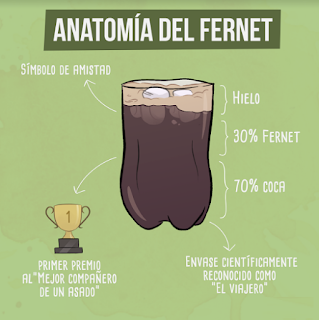
Answering part one is relatively simple, fernet is a liqueur aperitif produced mainly from herbs (approx. 40) and other ingredients like rhubarb, camomile and saffron fermented in barrels with grape alcohol. It is Italian in origin and supposedly brought to Argentina by Italian immigrants in the 19th century as a “digestive” drink. It can be consumed by itself (for example as a digestive after a meal), with soda water but by far the most popular way is with coca-cola. The proportions vary between regions in Argentina but generally it’s 2 or 3 ice cubes, 2 parts fernet, 6 parts coke (or 30% fernet, 70% coke for those who like it stronger). I was told once that hard core fernet drinkers use the Beverly Hills 90210 formula – 90% fernet, 2 ice cubes, 10% coke! I’d suggest for reasons in point 3 below you steer clear of this ratio.


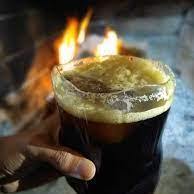
The second part of the question I’ll park for now and come back to as part 3 is easier to explain and perhaps a bit more fun. Those familiar with the taste of fernet will understand this – your first ever taste of fernet (either solo or with soda or coca-cola) will leave you with fernet face 😝. Think of sucking a child sucking a lemon for the first time…that’s the face you will make. It has also been called a bitter kiss that causes your eyes to close with disgust! Fernet is sour & quite bitter and although it looks inviting in the glass you’re probably experiencing a little bit of shock..so add that to your facial expression too. This is why I suggest to first time drinkers they try the 90210 rule in reverse – 10% Fernet as the sweetness of the 90% coke will help balance flavours better for you. Other than that, I can only say that it tastes herby, medicinal, a bit like Jägermeister if you have had that, but maybe with more aniseed flavour…and it is an acquired taste. If you want to order one in a bar you can just ask for a “fernecola”.
So why is it so popular in Argentina? This is a hard question to answer being that I am not Argentinian, though I have drunk my fair share of fernet both here and back in Australia and am a fan of it. I can vouch for the fact that it is a digestive – I’ve excused myself many times from the dinner table or party to go and sit on the throne. But I don’t honestly think that this makes it popular. After all people walk around the streets here (e.g. before football games, on the way to night clubs, at picnics, in the early hours of the morning) with a plastic coke bottle cut in half full of Fernet & cola – this is called a viajero (traveller) by the way. Mixing fernet with coke or soda became popularity back in the late 1980’s as a pseudo-cocktail and you will struggle to find a restaurant or bar that doesn’t serve it. It’s has deep roots in places with a lot of Italian heritage for example Cordoba which accounts for 30% of the national consumption.

The most popular and largest brand of fernet is Fratelli Branca and its recipe has not changed for 170 years. Amazingly 75% of the world’s production of fernet is consumed in Argentina and it has the only Fratelli Branca production facility outside of Italy. (Branca make a mint version and my advice is to stay away from this). 90%+ of Argentinian wine is exported internationally leaving less than 10% for local consumption, so just on these stats alone I’d say that fernet constitutes the title of Bebida Nacional. If that doesn’t finalise it for you then perhaps the fact that in 2014 the government of Argentina added it to a price-freeze program to protect it from skyrocketing inflation – I don’t know of any other country who has price protected a type of alcoholic drink! A bottle will cost you between $5-7 here vs. $90 in Australia.
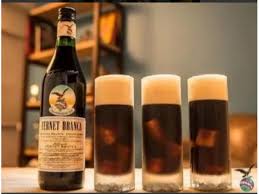

There are other fernet brands in Argentina that are vying for a part of the Branca dominated market and there are few “Fernetarias” popping up in popular nightlife areas like Palermo in Buenos Aires where you can try a “degustación of fernets”. Some of these artesian brands are nice, but but it’s a tough job to replace the king!
 3 meses en Argentina
Leave a comment